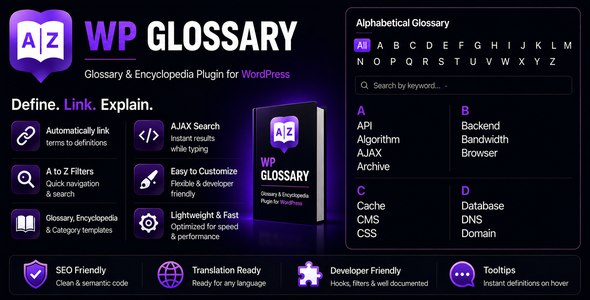
Building a comprehensive reference hub on WordPress often feels like a juggling act. You need a system that organizes complex information, keeps readers engaged, and strengthens your site’s internal linking structure without requiring a developer for every tweak. WP Glossary – Encyclopedia / Lexicon / Knowledge Base / Wiki / Dictionary by wpinstinct is a robust solution designed to consolidate all these needs into a single, intuitive plugin. Whether you are creating a corporate wiki, a niche dictionary, or a searchable product encyclopedia, this tool provides the architecture to display terms cleanly while automatically connecting them across your entire website. With over 2,260 sales on CodeCanyon, it has established itself as a reliable choice for publishers and developers who need more than just a simple list of definitions.
Key Features
WP Glossary is not a single-function plugin; it is a modular system that addresses how terms are displayed, linked, and explored. Here are the core capabilities that define its functionality:
- Custom Post Type Architecture: Every term benefits from the full WordPress block editor, allowing for rich formatting, media embedding, and custom fields. You are not restricted to a rigid input form.
- Automatic Linkify Module: This engine scans your content and automatically hyperlinks glossary terms to their dedicated definition pages. This improves navigation and creates powerful internal links for SEO without manual intervention.
- Interactive Hover Tooltips: When a term is linked, you can display a tooltip with the definition on hover. This keeps readers on the page while providing instant context, reducing bounce rates.
- Filterable A–Z Index: The shortcode-based index page includes alphabet filters, category filters, and instant search. The animations make browsing feel fluid rather than static.
- Custom Post Type Support: Do not want to migrate your content? The plugin allows you to use any existing post type (like Posts, Pages, or WooCommerce Products) as your glossary source.
- Related Posts Widget: On each term detail page, a widget automatically lists every page and post where that term is mentioned, creating a web of contextual discovery.
- Visual Customization Panel: Change colors, font sizes, tooltip themes, and layouts via the admin panel. No CSS coding is required to match your brand style.
- Multilingual & RTL Ready: Full translation support, WPML/Polylang compatibility, and custom alphabet sets allow you to build glossaries in Hebrew, Greek, Cyrillic, or any other language.
Who Is This For? Use Cases
This plugin is versatile enough to serve various digital projects. Its modular design means you can use only the features you need, making it suitable for both small blogs and large corporate portals.
Online Publishers and Magazines
For news sites or niche blogs, an encyclopedia of industry jargon helps new readers catch up quickly. By linking terms like “blockchain” or “supply chain management” to a dedicated explanation page, you keep your main articles clean while providing depth for those who want it. The tooltip feature ensures readers do not lose their place in a long-form piece.
E-Learning Platforms and Course Creators
If you are building a course hub or a digital textbook, the ability to group terms by category and alphabet is invaluable. Students can browse a structured lexicon, and the related posts widget helps them find all lessons that reference a specific concept, creating a cohesive learning path.
Corporate Knowledge Bases and Intranets
Large organizations often struggle with internal terminology and acronyms. WP Glossary allows you to build a professional knowledge base using the native WordPress editor. The ability to exclude specific HTML tags from linkification ensures that your navigation menus and headers remain clean while only body content gets linked.
Developers and Agencies
For agencies building client sites, the plugin’s support for custom post types and over 20 WordPress filters is a significant advantage. You can repurpose an existing custom post type—such as “Products” or “Services”—into a glossary index without duplicating content. The clean, documented codebase makes it easy to extend or integrate with existing themes.
Technical Details & Compatibility
Understanding the technical underpinnings is crucial for developers and site owners who need to ensure stability. This plugin is built to integrate smoothly into modern WordPress environments.
- WordPress & PHP Compatibility: The changelog indicates consistent testing with the latest WordPress versions and PHP 8.2, ensuring the plugin remains secure and performant on modern hosting stacks.
- Performance Optimizations: Version 3.0 introduced caching for glossary terms and queries, significantly reducing database load. Assets are conditionally enqueued—meaning scripts and styles only load when a glossary is present, preventing bloat on regular pages.
- Page Builder Friendly: Recent updates have focused on improving compatibility with third-party page builders and themes. This ensures shortcodes work correctly within drag-and-drop layouts.
- Multilingual Support: The plugin is fully compatible with WPML and Polylang, allowing each language to maintain its own glossary terms. Custom alphabet sets support non-Latin scripts, which is often a gap in competitor plugins.
- Accessibility: Tooltips are accessible via keyboard and screen readers, ensuring compliance with web accessibility standards.
- Theme Independence: Since the plugin uses a custom post type and shortcodes, it does not rely on specific theme functions. This makes it a safe addition to virtually any well-coded WordPress theme.
Pros and Cons
To make an informed decision, it is helpful to weigh the plugin’s strengths against its limitations.
Pros
- Comprehensive Feature Set: From auto-linking to related posts widgets, the plugin covers the entire glossary ecosystem rather than just displaying a list.
- No Coding Required for Styling: The custom styles module provides color pickers and font size controls, making it accessible for non-developers.
- SEO Benefits: Automatic internal linking to definition pages passes link equity and provides semantic context to search engines.
- Excellent Multilingual Support: The custom alphabet feature is rare and highly valuable for non-English sites.
- Strong Performance: Caching mechanisms and conditional asset loading ensure the plugin does not slow down your site.
- Value for Money: At $34.00, it replaces the need for multiple plugins (dictionary, tooltip, related posts) with a single unified system.
Cons
- Learning Curve for Shortcodes: While the basic shortcode is simple, advanced attributes require reading the documentation to fully utilize features like custom taxonomies.
- Dependency on Updates: As with all third-party plugins, ongoing compatibility relies on the author’s update schedule. However, wpinstinct has a solid track record of consistent updates.
- Tooltip Limitations on Touch Devices: While touch device support exists, hover-based interactions are inherently less intuitive on mobile, though the plugin offers options to manage this.
Frequently Asked Questions
Before purchasing, users often have specific questions about implementation and licensing. Here are answers to the most common queries regarding this plugin.
Can I use WP Glossary with my existing WooCommerce products instead of creating new terms?
Yes. The plugin allows you to select any existing post type as the source for your glossary. By using the post_type shortcode attribute, you can display a glossary of products grouped alphabetically or by category. Furthermore, the taxonomy attribute allows you to group these products by their existing categories (e.g., product_cat), making it a powerful tool for e-commerce navigation.
Does the automatic linkify feature affect my site’s performance on large posts?
The developers have optimized this module specifically for performance. Version 3.4 introduced caching to reduce database queries, and the linkify engine was refined to reduce DOM cycles. The plugin also allows you to set a limit on the number of times a term is linked per page and lets you exclude specific HTML tags. This ensures that even on content-heavy pages, the script runs efficiently without causing layout shifts or slow load times.
Is the plugin translation-ready for a non-English website?
Absolutely. Every string within the plugin is translation-ready, and it is fully compatible with WPML and Polylang. A standout feature is the ability to define custom alphabet sets. If your language uses a different script, such as Hebrew or Greek, you can replace the default A–Z filters with your specific character set, ensuring the index organizes terms correctly for your audience.
Final Verdict
In a crowded market of dictionary and wiki plugins, WP Glossary – Encyclopedia / Lexicon / Knowledge Base / Wiki / Dictionary distinguishes itself through its comprehensive approach to content navigation. It is not merely a list maker; it is an internal linking engine that weaves your content together. The combination of auto-linkification, hover tooltips, and a related posts widget creates a user experience that encourages exploration and reduces friction. For SEO professionals, the automatic internal linking is a significant asset, helping to distribute page authority across your domain. The plugin’s maturity is evident in its changelog, which shows years of refinement, security fixes, and performance enhancements by wpinstinct. With over 2,260 sales, it has a proven user base. At $34.00, the return on investment is clear when you consider the cost of hiring a developer to build custom functionality or the price of multiple plugins to achieve the same result. If you are serious about building a comprehensive resource hub on WordPress, this plugin offers the power, flexibility, and polish to get the job done.
Ready to transform your content into a fully connected knowledge base? Take control of your terminology and enhance your site’s usability today by purchasing WP Glossary from CodeCanyon.