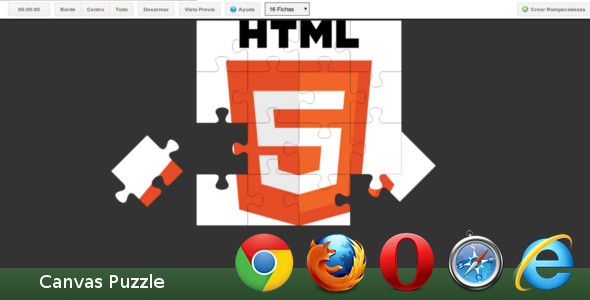
Canvas Puzzle is a lightweight HTML5 jigsaw puzzle script that lets you turn any image into a fully playable drag-and-drop puzzle directly in the browser. Built by developer sney2002 and sold on CodeCanyon, it holds the distinction of being the first HTML5 game published on the marketplace — a milestone that speaks to both its longevity and its foundational role in the HTML5 gaming space. Whether you run a blog, an agency, or a niche entertainment site, Canvas Puzzle gives you a fast, customisable, and genuinely easy-to-implement way to add interactive puzzle content that works on desktop and iPad alike.
Key Features
- Drag-and-drop image loading — On Firefox and Chrome, users can drag an image straight from their desktop into the puzzle area to instantly generate a playable jigsaw. No upload forms, no server-side processing, just immediate interaction.
- iPad support — The puzzle is fully playable on iPad, making it accessible to touch-screen users without requiring a separate build or app.
- Infinite piece counts — There is no hard cap on the number of puzzle pieces. You can configure anything from a simple handful of pieces to a dense, challenging grid.
- Works with any image — Any image format the browser can render becomes puzzle material. There is no dependency on a specific file type or dimension.
- Configurable default piece count — Set how many pieces appear by default so the puzzle loads at your preferred difficulty level.
- Optional piece rotation — Rotation of puzzle pieces can be enabled or disabled depending on how challenging you want the experience to be.
- Automatic shuffle on load — Pieces are shuffled automatically when the app initialises, so every session starts fresh without manual setup.
- Redirect on completion — When the puzzle is solved, you can send the player to another page — ideal for funneling users toward a landing page, offer, or next step.
- IE<9 fallback — A fallback is included for older versions of Internet Explorer, extending reach to legacy browser users.
- Very lightweight — The script is small and clean, keeping page load times fast and avoiding bloat.
Who Is This For? Use Cases
Canvas Puzzle suits anyone who wants interactive, browser-based entertainment without building a game from scratch. Its simplicity is its strength — there is no complex engine to learn and no heavy dependency chain to manage.
Agencies and Freelancers
Client work often calls for engagement mechanics that are quick to deploy. Canvas Puzzle can be dropped into a campaign microsite, a product launch page, or a branded interactive experience. The redirect-on-completion feature is particularly useful here: solve the puzzle, land on the offer. For agencies billing by deliverable, the low $13.00 price point means near-zero cost overhead per project.
Bloggers and Content Publishers
Puzzle content increases time-on-site and gives readers something to do beyond scrolling. A blogger can let visitors drag in their own photos, turning a post into a mini interactive toy. Because the puzzle accepts any image, there is no need to prepare assets in advance.
Game and Entertainment Portals
Sites that aggregate casual games benefit from a script that is genuinely lightweight and works across modern browsers plus iPad. Canvas Puzzle adds a jigsaw category to a portal without the weight of a full game engine.
Developers and Tinkerers
The clean, simple design makes Canvas Puzzle a reasonable starting point for customisation. Developers who want to wrap a puzzle mechanic inside a larger HTML5 project can use it as a base and extend from there.
Educational and Training Contexts
Puzzles are a familiar learning device. Trainers and educators can use drag-and-drop image puzzles as a light engagement activity, with the redirect feature pointing learners to the next module or resource.
Technical Details & Compatibility
Canvas Puzzle is built on HTML5 canvas and is compatible with all modern browsers. The drag-and-drop image loading feature is specified for Firefox and Chrome, so it is worth noting that desktop image dragging is best experienced in those two browsers.
iPad support is explicitly included, which means the puzzle responds to touch input rather than relying solely on mouse events. This matters for any audience that browses on tablets.
An IE<9 fallback is provided, extending compatibility to older Internet Explorer versions. While legacy IE traffic is now minimal, the fallback signals that the developer considered a broad browser matrix rather than targeting only the newest environments.
Because the script is described as very light-weight, it should have a negligible impact on page performance. There is no mention of external libraries or frameworks, which keeps the dependency footprint small and reduces the chance of conflicts with other scripts on your page.
The product listing includes documentation, which helps with setup and configuration. Configuration options referenced in the description include the default number of pieces, piece rotation on or off, shuffle-on-load behaviour, and the completion redirect URL.
Canvas Puzzle is distributed through CodeCanyon, so licensing and download delivery follow the standard Envato marketplace process.
Pros and Cons
Pros
- Extremely affordable — at $13.00, it costs less than a single hour of most freelance rates.
- Proven track record — 1,697 sales is strong social proof for a niche HTML5 puzzle script.
- First HTML5 game on CodeCanyon — a notable historical credential from developer sney2002.
- Works on iPad — touch support broadens the usable audience.
- Any image, infinite pieces — flexible enough for casual and hard puzzles alike.
- Redirect on completion — turns a game into a conversion or navigation tool.
- Lightweight and dependency-free — minimal performance impact.
- Documentation included — reduces setup friction.
- IE<9 fallback — broader legacy reach than many modern equivalents.
Cons
- Desktop image dragging is limited to Firefox and Chrome — other browsers may not support the drag-from-desktop workflow.
- No rating shown in the listing data — buyers cannot rely on a star rating as a quality signal.
- Simple, clean design — this is a strength for some and a limitation for anyone wanting a heavily stylised, themed interface out of the box.
- Legacy IE fallback — useful for old traffic, but irrelevant for modern-only audiences.
- Niche scope — it does one thing (jigsaw puzzles) rather than offering multiple game types.
Frequently Asked Questions
Does Canvas Puzzle work on mobile devices and tablets?
Yes. The product description explicitly states that it works on iPad, which means touch interaction is supported. Desktop drag-and-drop image loading is specified for Firefox and Chrome, so the experience differs slightly between desktop and tablet, but the puzzle itself is playable on iPad.
Do I need to upload images to a server to create a puzzle?
No. In Firefox and Chrome, users can drag an image directly from their desktop into the puzzle area. The image is used client-side to generate the jigsaw, so there is no requirement to pre-upload assets to your server for that workflow.
Can I change the number of puzzle pieces and turn off piece rotation?
Yes. Canvas Puzzle supports an infinite number of pieces, and you can choose the default number of pieces that appears when the app loads. Piece rotation can also be disabled if you want a simpler, more accessible puzzle experience.
Final Verdict
Canvas Puzzle from developer sney2002 is a focused, well-established HTML5 jigsaw script with a genuinely impressive pedigree: it was the first HTML5 game published on CodeCanyon, and it has since accumulated 1,697 sales. That combination of marketplace seniority and sustained sales volume is meaningful social proof — buyers are not taking a gamble on an unproven script.
At $13.00, the value proposition is straightforward. You get drag-and-drop image loading, iPad support, infinite piece counts, configurable defaults, optional rotation, shuffle-on-load, a completion redirect, an IE<9 fallback, and documentation — all in a very light-weight package. For agencies, bloggers, portal owners, and developers who need a jigsaw mechanic without the overhead of a full game engine, that is a difficult combination to beat on price.
The limitations are real but modest. Desktop image dragging is scoped to Firefox and Chrome, the design is intentionally simple rather than flashy, and there is no star rating in the listing data to lean on. None of these undermine the core functionality, and for most use cases they are non-issues.
If you want to add interactive puzzle content to a site quickly, cheaply, and without a heavy technical commitment, Canvas Puzzle is a sensible purchase. Head to CodeCanyon, pick it up for $13.00, and you can have a working, customisable HTML5 jigsaw live on your site the same day.