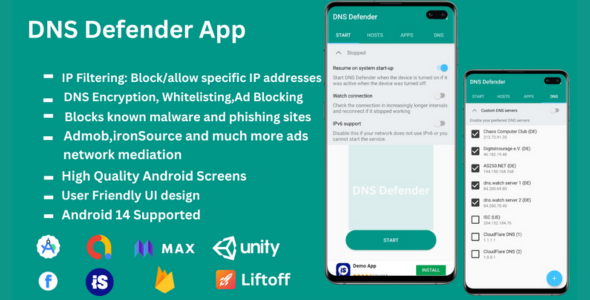
For Android users seeking to reclaim control over their digital footprint, a robust DNS filtering and encryption solution is no longer a luxury—it’s a necessity. DNS Defender is a comprehensive Android application that operates at the foundational level of your internet connection, intercepting and filtering Domain Name System queries to block malicious, intrusive, and unwanted content before it ever reaches your device. More than just an ad blocker, it serves as a privacy shield, a security sentinel, and a customizable network tool, all while offering developers a monetization pathway through integrated ad mediation. This powerful app addresses the growing concerns over online tracking, malware, and data privacy by combining DNS over HTTPS (DoH) and DNS over TLS (DoT) encryption with highly configurable host-based filtering.
Key Features
- Core DNS Filtering & Blocking: At its heart, DNS Defender functions as a DNS filter and changer, allowing you to set any trusted upstream DNS server. It actively blocks access to domains on its filter lists, targeting ads, malware, phishing sites, and trackers directly at the resolution stage.
- Advanced DNS Encryption: Prioritize your privacy with support for encrypted DNS protocols. Choose between DNS over HTTPS (DoH) and DNS over TLS (DoT) to ensure your DNS queries are shielded from eavesdropping and manipulation by ISPs or malicious actors on public Wi-Fi.
- Comprehensive Ad Mediation & Monetization: For developers, the app comes pre-integrated with major ads mediation platforms, including AdMob, AppLovin MAX, Unity, ironSource, and Liftoff. This allows for streamlined revenue generation by optimizing fill rates and earnings across multiple networks.
- Dynamic & Customizable Blocklists: Go beyond the default filters. The app supports adding user-defined blocklists (hosts files), enabling you to tailor protection against specific threats or nuisance content. Coupled with whitelisting capabilities, you have precise control over what gets blocked.
- Real-Time Transparency & Logging: Gain unparalleled insight into your device’s network activity. The live DNS query log acts as an eye-opener, revealing all domain requests made by your apps in the background, fostering awareness and aiding in troubleshooting.
- Enhanced Performance & Security Tools: Features like DNS caching accelerate repeated queries, while IP filtering and customizable port settings provide granular network control. The inclusion of a JSON configuration file offers flexibility for power users.
- Modern Development Standards: Built with the latest Android SDK (API 34), DNS Defender offers full compatibility with Android 14, ensuring it meets current platform requirements and security standards.
Who Is This For? Use Cases
DNS Defender caters to a wide spectrum of Android users, from privacy-conscious individuals to developers looking to deploy a feature-rich utility. Its layered functionality makes it applicable in several key scenarios.
The Privacy-Focused Everyday User
For anyone tired of intrusive ads, concerned about data tracking, or frequently using public Wi-Fi, DNS Defender is a first line of defense. It silently blocks ad-serving and tracking domains across all apps and browsers, not just the web, reducing data usage and clutter. The DoH/DoT encryption ensures that even your DNS provider cannot log your browsing habits, offering a significant privacy upgrade over standard connections.
The Security-Aware Power User
Tech-savvy individuals and IT professionals can leverage DNS Defender as a proactive security tool. By blocking known malware and phishing domains at the DNS level, it prevents connections to dangerous sites before any data is exchanged. The ability to import specialized security blocklists and monitor the live query log makes it an invaluable tool for auditing app behavior and identifying potential spyware or data leaks on a device.
The Android App Developer & Entrepreneur
For developers on platforms like CodeCanyon, this source code represents a ready-made business opportunity. The deep integration with leading ad mediation networks like ironSource, AppLovin MAX, and Unity provides a monetization engine out of the box. You can customize, rebrand, and publish a powerful utility app with a clear revenue model, tapping into the high demand for privacy and ad-blocking tools on the Google Play Store.
The Parent or Guardian
While not exclusively a parental control app, DNS Defender can be configured to help filter inappropriate content. By applying blocklists that target adult content or specific categories of websites, it can add a layer of DNS-level filtering on a child’s Android device, complementing other parental control measures.
Technical Details & Compatibility
DNS Defender is developed as a native Android application. The provided description indicates it is built with the latest Android SDK 34, guaranteeing full compatibility and optimization for Android 14 devices. It should maintain backward compatibility with several previous versions of Android, though the specific minimum API level would be detailed in the source code documentation. The app requires VPN permissions to intercept DNS traffic—a standard and secure method for local DNS filtering on Android. Its lightweight design ensures it runs efficiently even on low-resource devices. The integration of multiple ad networks via mediation suggests the use of SDKs for AdMob, AppLovin MAX, Unity Ads, and ironSource, which would be included and configured within the project.
Pros and Cons
Pros
- Comprehensive Privacy Protection: Combines ad/tracker blocking with mandatory DNS encryption (DoH/DoT), addressing privacy from multiple angles.
- System-Wide Filtering: Works across all apps and browsers, not just within a single application, providing universal protection.
- Powerful Monetization for Developers: Pre-integrated mediation with all major ad networks significantly reduces development time and creates immediate revenue potential.
- High Customizability: Support for custom blocklists, whitelists, IP filtering, DNS server choices, and JSON configuration appeals to advanced users.
- Transparent Operation: The live query log offers valuable insight into device network activity, promoting user education and trust.
- Modern & Maintained Codebase: Support for Android 14 and SDK 34 indicates an actively maintained project that adheres to Google’s latest guidelines.
Cons
- Requires Persistent VPN Profile: Like all DNS-filtering apps on Android, it must run a local VPN to capture traffic, which may prevent the use of other VPN services simultaneously (unless they support split-tunneling or are configured at the router level).
- Potential for Breakage: Some apps or services may detect and attempt to circumvent DNS-based ad blocking, requiring ongoing list maintenance and potential whitelisting.
- Learning Curve for Advanced Features: While basic blocking works out-of-the-box, maximizing its potential with custom blocklists and JSON configuration requires technical familiarity.
- Battery Impact Considerations: As a service that constantly monitors network traffic, it may have a minor impact on battery life, though its lightweight design aims to minimize this.
Frequently Asked Questions
Does DNS Defender work with other VPN services?
Due to Android’s system limitations, you cannot run two VPN connections simultaneously at the device level. DNS Defender uses a local VPN to intercept DNS requests. Therefore, you cannot use it concurrently with a traditional privacy VPN app on the same device. However, if your primary VPN service offers built-in ad blocking or DNS filtering features, you may not need DNS Defender. Alternatively, some VPNs allow for custom DNS settings, which could be pointed to an external encrypted DNS server, though this would lack DNS Defender’s local filtering and logging capabilities.
How does the ad mediation integration benefit me as a buyer of this source code?
If you are a developer purchasing this code from CodeCanyon, the pre-integrated ad mediation is a major time-saver and revenue driver. Instead of manually integrating and testing multiple ad network SDKs, you receive a unified system that automatically optimizes which ad network serves an impression to maximize your earnings. This mediation layer handles the complexity, allowing you to focus on customization, branding, and publishing the app, with a proven monetization strategy already in place.
Can I use my own blocklists, like the ones from OISD or Steven Black?
Absolutely. A key strength of DNS Defender is its support for user-defined blocklists. You can typically add lists by URL or by importing a hosts-formatted file. This means you can incorporate popular, community-maintained lists like OISD (balanced blocking), Steven Black’s list, or specialized lists targeting malware, gambling, or social media. This flexibility allows you to tailor the blocking intensity and focus to your specific needs, making the app far more powerful than solutions with static, unchangeable filters.
Final Verdict
DNS Defender stands out as a sophisticated and commercially viable solution in the realm of Android privacy tools. It successfully bridges the gap between a user-friendly privacy app and a developer-ready monetization platform. For the end-user, it delivers a potent combination of DNS-level ad blocking, essential malware protection, and critical DNS encryption, all through an interface that provides both simplicity and deep control. The live query log alone is a transformative feature for understanding device behavior.
For the developer or entrepreneur, the value proposition is even clearer. The hard work of integrating complex ad mediation is already done, presenting a turnkey project with immediate revenue potential. The modern codebase ensures longevity and compliance. Whether your goal is to enhance your personal Android security or to launch a successful utility app on the Play Store, DNS Defender provides a robust, feature-packed foundation. It is a compelling investment for anyone serious about Android privacy or app development.
To experience the difference of a secured and private DNS layer, or to explore the commercial potential of this fully-featured source code, detailed documentation, demos, and purchase options are available on its CodeCanyon product page. Take the step to control your digital traffic at its source.