Building a coherent internal linking structure is one of the few SEO tasks that delivers compounding returns without depending on external factors. Interlinks Manager – Internal Links Optimizer for WordPress is a CodeCanyon plugin developed by DAEXT that gives site owners a complete toolkit for auditing, generating, tracking, and refining the internal links across an entire WordPress installation. Instead of guessing which posts deserve more links or manually hunting for related content, the plugin turns internal linking into a measurable, data-driven process. It is built for publishers, SEO specialists, and store owners who understand that link juice distribution and contextual relevance directly influence rankings, conversions, and time on site.
Key Features
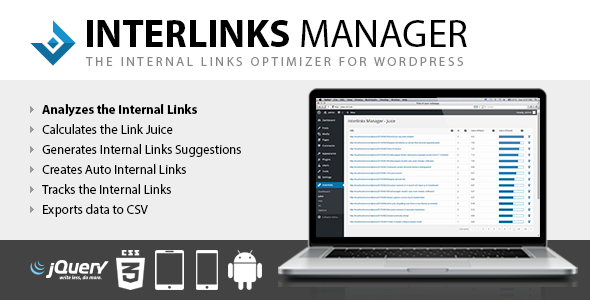
- Internal link analysis dashboard — Using regular expressions applied to your posts, the plugin reports the number of manual internal links, the number of auto internal links, the visits generated by internal links, and an overall optimization status for each piece of content.
- Link juice calculator — The dedicated Juice menu maps how link equity flows across your URLs and provides, for every URL, a detailed breakdown of each individual link contributing to its total link juice.
- Interlinks Suggestions meta box — An algorithm surfaces related articles while you edit a post, saving the manual effort of searching for suitable internal link targets. It can prioritize posts whose titles share words with the current post, and include or exclude content by category, tag, or custom post type.
- Auto internal links (AIL) — Convert chosen keywords or phrases into internal links automatically. This is ideal for glossary terms, product page references, or pushing traffic toward your best-performing articles.
- Granular autolink controls — Define keyword boundaries, select which post types receive autolinks, cap the number of conversions per keyword and per post, choose case sensitivity, open links in new tabs, apply rel=”nofollow”, and set substitution priority so the most important keywords always get converted.
- Protected tags list — A customizable list of protected tags prevents accidental keyword substitutions inside sensitive HTML elements.
- Test mode — Build autolinks and review statistics privately before exposing them to visitors and search engines, then activate once you are satisfied with the results.
- Click tracking — Record every visitor click on internal links, including the source post, the date, the target URL, and whether the link was manual or automatic. Tracking can be disabled entirely if you prefer.
- Interlinks optimization meta box — Tells you whether a post has an optimized number of internal links, based on your own custom-defined values and the length of the post rather than fixed criteria.
- CSV export — Export internal link data, link juice data, and tracked clicks to CSV for analysis, sharing, or printing in spreadsheet software.
- Role-based access — Assign capabilities so specific user roles, such as contributors or editors, can access only the plugin features you choose.
- Gutenberg block-level control — Select exactly which Gutenberg blocks receive autolinks, avoiding conflicts with block-based layouts.
- Multisite and multilanguage ready — Supports both network activation and single-site activation on a WordPress Network, and ships in English and Italian with translation support.
Who Is This For? Use Cases
SEO Agencies and Consultants
Agencies managing multiple client sites need repeatable, evidence-based internal linking workflows. The analysis dashboard, link juice reports, and CSV exports make it straightforward to audit a client site, identify under-linked posts, and present measurable results. Role-based access also lets junior team members work on suggestions without touching global settings.
Bloggers and Content Publishers
Large archives are where internal linking usually breaks down. The Interlinks Suggestions meta box and the optimization meta box help bloggers keep every new post connected to relevant older content, while the AIL feature can automatically link glossary terms or recurring topics across thousands of existing articles.
E-commerce Stores
Online stores with content-heavy blogs can convert phrases such as “our products,” “premium area,” or “the newsletter” into automatic internal links pointing to commercial pages. Combined with click tracking, this turns editorial content into a measurable traffic source for product and conversion pages.
Knowledge Bases and Wiki-Style Sites
Documentation sites and glossaries benefit enormously from converting defined terms into links to their definition pages. The keyword boundary and protected tags options keep these substitutions clean and predictable.
Developers and Technical Site Owners
Server administrators and technical publishers can use autolinks to elevate their best tutorials — for example, converting “configure a server” or “CentOS guide” into links pointing to flagship articles. The plugin relies on regular expressions and your own server CPU, with no external services involved.
Technical Details & Compatibility
Interlinks Manager is a self-contained WordPress plugin. All analysis is performed locally using regular expressions and optimized database queries, so there are no API keys, subscriptions, or third-party services to configure, and analyses can be run an unlimited number of times.
Performance is a stated priority. According to the developer, the plugin can retrieve internal link or link juice information for 100,000 posts in roughly 120 seconds, with the caveat that other factors may affect timing. For typical use on the latest 1,000 posts, results are generated almost instantly. To prevent excessive waiting times or PHP memory exhaustion, a single analysis iteration is capped at 100,000 posts, though the plugin can be used on sites with millions of posts.
Compatibility highlights include support for the Gutenberg block editor with block-level autolink selection, WordPress Multisite with both network and single-site activation, and multilingual setups. The plugin makes use of the Chosen and Handsontable libraries under the MIT license. It ships in English and Italian by default.
Update history is a strong indicator of long-term reliability. The plugin has received consistent maintenance releases from its first version in November 2015 through version 1.43 in March 2026, covering WordPress core compatibility fixes, UI modernization, PHP notice resolution, and new features such as relative URL detection in link analysis.
Important Product Notice
Prospective buyers should be aware that Interlinks Manager has been superseded by Link Manager, a broader plugin that includes all Interlinks Manager features plus additional link management capabilities. Interlinks Manager will continue to receive maintenance updates for compatibility and security until July 8, 2027, and will be removed from Envato Market on December 31, 2026. Existing Envato customers can email [email protected] to request a migration discount coupon for Link Manager, and a migration guide is available for transferring data.
Pros and Cons
Pros
- Comprehensive internal linking toolkit covering analysis, suggestions, automation, tracking, and optimization in one plugin.
- No external services or recurring API costs — all processing happens on your own server.
- Impressive scale, handling up to 100,000 posts per analysis iteration.
- Granular autolink controls reduce the risk of over-linking or disrupting SEO.
- Test mode allows safe experimentation before changes go live.
- Gutenberg, Multisite, and multilanguage support built in.
- Role-based permissions suit team and agency workflows.
- CSV exports make reporting and custom analysis simple.
- Over 1,887 sales on CodeCanyon and a consistent update record since 2015.
- At $149, it replaces several separate SEO tools with a single one-time purchase.
Cons
- The plugin is being phased out in favor of Link Manager, so new feature development has moved elsewhere.
- It will be removed from Envato Market on December 31, 2026, which limits long-term availability on that marketplace.
- Maintenance support ends July 8, 2027, so buyers planning long-term projects should factor in migration.
- Analysis is capped at 100,000 posts per iteration, which may require multiple runs on extremely large sites.
- Autolink behavior depends on careful configuration; poorly chosen keywords can still produce awkward results.
Frequently Asked Questions
Can I still buy Interlinks Manager and use it long term?
Yes, but with a defined timeline. Interlinks Manager remains available on Envato Market until December 31, 2026, and receives maintenance updates for compatibility and security until July 8, 2027. If you need ongoing feature development, the developer recommends migrating to Link Manager, and previous Envato buyers can request a migration discount coupon by emailing [email protected].
Does the plugin work with Gutenberg and WordPress Multisite?
It does. Interlinks Manager is Gutenberg ready and lets you choose precisely which blocks receive autolinks, which avoids conflicts with block-based content. On WordPress Multisite, it supports both network activation across all sites in one step and manual single-site activation.
Do the internal link analyses require any external service or subscription?
No. The plugin uses regular expressions and your own server resources to analyze posts, so there are no external services, API keys, or usage limits. You can run analyses as many times as you want, and all results can be exported to CSV for use in spreadsheet software.
Final Verdict
Interlinks Manager – Internal Links Optimizer for WordPress solves a problem most SEO plugins only touch on the surface: the systematic management of internal links at scale. Its combination of link analysis, link juice reporting, algorithmic suggestions, controlled automation, and click tracking gives site owners a complete feedback loop for one of the highest-leverage ranking factors available. The developer, DAEXT, has maintained the plugin continuously since 2015, and 1,887 sales on CodeCanyon reflect sustained trust from the WordPress community. At $149, it delivers strong value compared with assembling multiple standalone SEO tools, particularly for agencies and publishers managing large content archives.
The one caveat is the product’s transition. Because Interlinks Manager is being superseded by Link Manager, buyers should treat this as a mature, stable tool with a clear migration path rather than a platform for future features. For anyone who needs proven internal linking functionality today — and a straightforward route to the successor plugin later — it remains a smart, cost-effective investment. If internal linking is an untapped opportunity on your site, purchase Interlinks Manager now while it is still available on Envato Market and start turning your existing content into a structured, measurable link network.