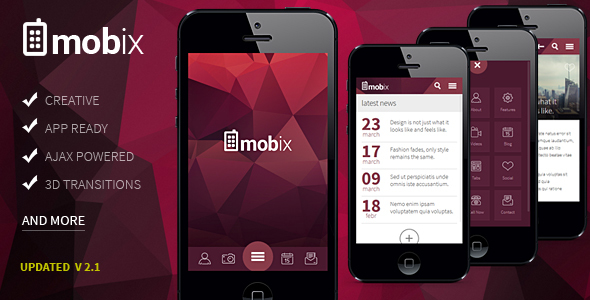
Building a polished mobile experience usually means choosing between the rigidity of a full framework and the tedium of writing every screen from scratch. Mobix – HTML Mobile Template sits in the sweet spot between those two extremes. Created by the developer mobiokit and sold on ThemeForest, this template gives you a complete set of mobile-ready pages and design elements that adapt to any screen resolution. Whether you are prototyping a mobile website, assembling a mobile web app, or preparing a hybrid build for a native wrapper, Mobix provides the structural foundation so you can focus on content and branding rather than boilerplate layout work.
The template has already been purchased 1,533 times, a strong signal that developers and designers find it dependable for real projects. At just $19, it also undercuts most custom design work by a wide margin. Below is a detailed breakdown of what Mobix includes, who benefits most from it, and what to consider before buying.
Key Features
- Flexible, resolution-adaptive layout — The template scales fluidly across mobile screen sizes, so the same markup looks correct on small phones and larger phablets without manual breakpoint rewriting.
- Multiple pre-built pages — Mobix ships with a range of page templates covering the common sections a mobile site or app needs, reducing the time spent designing screens from zero.
- Rich library of design elements — Buttons, lists, navigation components, and other UI building blocks are included so you can assemble almost any section of a website or app.
- Ajax and jQuery page loading — Pages load dynamically rather than through full browser refreshes, which produces the smooth, snappy transitions users associate with native applications.
- Native app integration ready — The template can be wrapped with solutions such as PhoneGap, allowing the same HTML codebase to power a packaged native app.
- Mobile-first structure — Everything is designed around mobile design and mobile layout principles rather than being a desktop theme squeezed onto a small screen.
- Mobile web app foundation — The combination of dynamic loading and app-style navigation makes Mobix suitable as the front end of a browser-based mobile web app.
Who Is This For? Use Cases
Mobix is a general-purpose mobile template, which means its audience is broad. The following groups tend to get the most value from it.
Agencies and Freelancers
When a client needs a mobile presence quickly, starting from a tested template shortens the delivery timeline considerably. Agencies can rebrand the design elements, swap in client content, and hand over a finished mobile site without building the layout system from the ground up. Freelancers benefit even more, since a single $19 purchase can serve multiple client projects and protect their margins.
Mobile Web App Developers
The Ajax and jQuery dynamic page loading is the standout feature for this audience. Because navigation happens without full page reloads, the result feels like an installed application rather than a website. Developers building dashboards, portals, or lightweight tools can use Mobix as the presentation layer and connect it to their own backend logic.
Hybrid and Native App Builders
Teams using PhoneGap or similar wrappers can take the Mobix HTML directly into their packaging pipeline. This is an efficient route for anyone who wants an app-store presence without committing to fully native development for both iOS and Android.
Startups and SaaS Teams
Early-stage products often need a credible mobile interface before engineering resources are fully allocated. Mobix provides that interface immediately, letting founders demo a realistic mobile experience to investors, testers, or early users while the real application is still being built.
Bloggers and Content Publishers
Publishers who want a dedicated mobile reading experience, separate from a responsive desktop theme, can use the template’s page structures to present articles, categories, and navigation in a format optimized for thumb-driven browsing.
E-commerce and Service Businesses
Any business whose customers browse primarily on phones can use Mobix to build a fast, app-like storefront or booking flow. The dynamic loading keeps customers moving between product or service pages without the friction of repeated page refreshes.
Technical Details & Compatibility
Mobix is delivered as an HTML mobile template, not a WordPress theme. That distinction matters: there is no CMS dependency, no plugin ecosystem to manage, and no database required. You deploy static files to any web host and the template runs.
- Technology stack: Standard HTML, CSS, and JavaScript, with Ajax and jQuery handling dynamic page transitions.
- Layout behavior: A flexible layout engineered to adapt to any mobile resolution, covering the full range of common device widths.
- Native packaging: Compatible with hybrid app wrappers such as PhoneGap for producing installable native applications.
- Browser support: Because it relies on widely supported web standards and jQuery, it renders consistently across modern mobile browsers including Safari on iOS and Chrome on Android.
- Mobile responsiveness: Responsiveness is the core design premise rather than an added feature, so the interface is built for touch interaction from the start.
- Performance: Dynamic loading reduces the amount of data transferred during navigation, which helps perceived speed on mobile networks.
- Hosting requirements: Any standard web server capable of serving static files. No special server software is needed.
One practical note: because pages load via Ajax, the template should be tested on your own hosting environment early. Server configuration and file paths affect how dynamic requests resolve, and confirming that behavior before customization saves time later.
Pros and Cons
Pros
- Excellent value at $19 — a complete mobile UI foundation for less than the cost of an hour of professional design time.
- Proven track record — 1,533 sales on ThemeForest indicate the template has been tested across many real projects.
- App-like navigation — Ajax and jQuery page loading delivers the smooth transitions users expect from native apps.
- Flexible across resolutions — one codebase adapts to a wide range of mobile screen sizes.
- Multi-purpose — suitable for mobile websites, mobile web apps, and PhoneGap-wrapped native apps.
- No platform lock-in — plain HTML means you can host it anywhere and integrate it with any backend.
- Comprehensive page and element coverage — enough built-in sections to assemble virtually any part of a mobile product.
Cons
- Not a WordPress theme — buyers expecting a CMS-ready product will need to integrate it manually or look elsewhere.
- Requires HTML and jQuery familiarity — customization assumes comfort editing markup, stylesheets, and scripts.
- Ajax navigation needs testing — dynamic loading can behave differently depending on server configuration and hosting setup.
- Mobile-only scope — it is designed for small screens, so it is not a solution for a full desktop site.
- Design refresh depends on the author — visual updates and new components come from mobiokit rather than from a community plugin ecosystem.
Frequently Asked Questions
Is Mobix a WordPress theme or a standalone HTML template?
Mobix is a standalone HTML mobile template. It is not built as a WordPress theme, so it does not install through the WordPress dashboard and does not require a CMS at all. You upload the files to any web host and the template runs directly in the browser. Developers who want to use it inside WordPress typically convert the markup into a custom theme or embed the pages within an existing WordPress installation.
Can I use Mobix to build a real native app for the App Store or Google Play?
Yes, indirectly. The template is designed to integrate with native app packaging solutions such as PhoneGap. You take the HTML, CSS, and JavaScript that make up Mobix, wrap them using a hybrid app tool, and compile the result into an installable application. This approach lets you ship to both major app stores from a single codebase, though the final build process and store submission are handled by your chosen packaging tool rather than by the template itself.
How difficult is it to customize the design and add my own pages?
Customization requires working knowledge of HTML, CSS, and jQuery, since the template is code-based rather than controlled through a visual builder. Changing colors, typography, and branding is straightforward for anyone comfortable with stylesheets. Adding new pages means duplicating an existing page structure and adapting the markup, then ensuring the new page is registered so the Ajax navigation can load it dynamically. Developers with front-end experience will find the process routine; complete beginners may need to invest time learning the basics first.
Final Verdict
Mobix – HTML Mobile Template earns its place as a practical, affordable starting point for mobile interface work. With 1,533 sales behind it and a price of just $19, the risk-to-reward calculation is heavily in the buyer’s favor. Developer mobiokit has delivered a template that covers the essentials well: a flexible layout that adapts to any mobile resolution, a solid set of pages and design elements, and Ajax-driven navigation that gives the finished product a genuine app feel.
The template is not for everyone. If you need a drag-and-drop WordPress theme or have no interest in touching code, this is not the right tool. But if you are a developer, designer, agency, or startup founder who is comfortable in HTML and jQuery and needs a fast route to a credible mobile presence, Mobix removes weeks of layout work for the price of a takeout lunch. It works as a mobile website, as the front end of a mobile web app, and as the source for a PhoneGap-packaged native build — three use cases from one purchase.
For anyone weighing the cost of custom mobile design against a proven, widely adopted template, the answer is straightforward. Head to ThemeForest, purchase Mobix for $19, and start building your mobile experience today.