The challenge of delivering intuitive zoom and pan functionality across both touchscreen and desktop environments has long been a pain point for web developers. Users expect the familiar pinch-to-zoom gesture on their phones, but they also need a smooth scroll-wheel experience on a laptop. The Pinch Zoomer jQuery Plugin by RonFeliciano is a specialized JavaScript solution designed to bridge this gap, offering a unified, easy-to-implement system for adding scalable, draggable content to any website. With over 2,600 sales on CodeCanyon, this plugin has established itself as a reliable tool for developers who need to present detailed images, maps, and interactive HTML content without building complex gesture recognition from scratch. It is built for a mobile-first world but retains full functionality for traditional mouse users, making it a versatile asset for modern web projects.
Key Features
Pinch Zoomer is not just a simple image magnifier; it is a comprehensive zooming engine for HTML content. The feature set has evolved through multiple versions to address developer feedback and modern browsing requirements. Here are the core capabilities that define this tool:
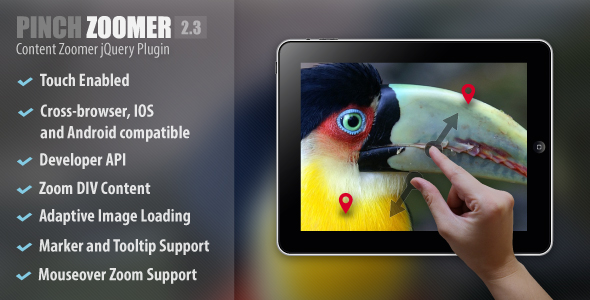
- Touch and Mouse Support: The plugin natively supports pinch-to-zoom gestures on iOS and Android devices while simultaneously providing mouse scroll zoom and drag functionality for desktop users. This dual-input approach ensures no user is left behind.
- Responsive and Adaptive: It is fully responsive, adapting to any screen size. The adaptive image loading feature prevents bandwidth waste by serving the correct image resolution based on the user’s viewport, which is critical for performance on mobile networks.
- HTML Content Zooming: Unlike basic plugins that only handle
<img>tags, Pinch Zoomer allows you to zoom in on any DIV content. This means you can scale text, graphics, and complex layouts seamlessly. - Marker and Tooltip System: Version 2.1 introduced markers, allowing developers to pin specific locations on the zoomable content. This is ideal for interactive maps, product hotspots, or floor plans. The accompanying tooltips can be repositioned or hidden when zooming to maintain a clean interface.
- Developer API and Events: The plugin exposes a robust API, including functions like
transformandzoomToMarker. This gives developers granular control over the zoom behavior, allowing for dynamic option changes and integration with external UI controls. - Fullscreen Toggle: A native fullscreen mode allows users to expand the content to fill their screen, removing clutter and focusing attention on the zoomable area—essential for small devices.
- Multi-Instance Support: You can initialize multiple zoomers on a single page without performance conflicts, making it suitable for galleries or product comparisons.
- Smart Scale Mode: The “smart” scale mode adjusts the zoom point intelligently, ensuring that the content stays centered and aligned correctly during scaling operations.
Who Is This For? Use Cases
The versatility of the Pinch Zoomer jQuery Plugin makes it applicable across various industries and project types. Its ability to handle both visual media and HTML structures opens up numerous possibilities.
Agencies and Web Developers
For digital agencies building responsive websites for clients, this plugin is a time-saver. Instead of writing custom JavaScript to handle touch events and CSS transforms, developers can implement a professional-grade zoom feature in a single line of code. It is particularly useful for portfolio sites, photography showcases, and real estate listings where clients expect high-resolution imagery to be explorable.
E-commerce and Product Visualization
Online stores benefit significantly from zoom functionality. Shoppers want to inspect product details, fabric textures, or electronic ports before purchasing. The marker and tooltip feature is perfect for highlighting product features or “buying guides” directly on the image. The adaptive loading ensures that thumbnail pages remain fast while the zoom view loads high-res assets only when requested.
Interactive Maps and Diagrams
Developers creating custom maps, seating charts, or technical schematics will find the marker system invaluable. You can plot specific locations and use the zoomToMarker API to create a guided tour of the content. This is effective for event venues, campus navigation, or instructional diagrams where users need to find specific points of interest.
Freelancers and Solo Creators
Freelancers who build websites for niche clients—such as artists, architects, or interior designers—need tools that “just work” without extensive configuration. Pinch Zoomer’s simple setup process allows solo developers to add complex interactions quickly, increasing project profitability without sacrificing quality.
Technical Details & Compatibility
Understanding the technical foundation of a plugin is crucial for integration planning. Pinch Zoomer is designed to be lightweight and compatible with modern web standards, though it does have specific library requirements.
To run the plugin, you must include three dependencies: jQuery, Hammer JS (for gesture recognition), and TweenMax (for smooth animations). The plugin no longer requires Modernizr, removing a common compatibility headache. Version 2.0 dropped support for IE8 and below and Android 2.2.x, meaning the plugin is optimized for modern browsers and operating systems. It remains compatible with older browsers like IE9 and above, ensuring a broad reach.
The plugin is fully responsive, maintaining the zoom factor even when the window is resized or the device orientation changes. It also utilizes native scrolling when the content is not zoomed, preserving the natural user experience on mobile devices. For performance, the controls are always visible (rather than fading in/out), which reduces CPU overhead and improves responsiveness on lower-end devices.
Pros and Cons
No plugin is perfect for every scenario. Here is a balanced look at the strengths and potential limitations of Pinch Zoomer.
Pros
- Cross-Platform Consistency: The plugin unifies touch and mouse interactions, ensuring a consistent experience across devices without needing separate code paths.
- Impressive Performance: With the removal of Modernizr and the addition of hardware acceleration options for markers, the plugin is optimized for smooth 60fps interactions.
- Active Development: RonFeliciano has consistently updated the plugin (Versions 2.0 through 2.3), adding requested features like mouse-over zoom and smart scaling, which indicates good long-term support.
- Extensive Documentation: The plugin includes multiple examples (Dynamic Options, Multilayer Zoom, Maps with Markers) that help developers understand complex use cases quickly.
- Affordable Pricing: At just $10.00, it offers a high return on investment compared to the hours of JavaScript development it saves.
Cons
- Dependency Requirements: You must include TweenMax and Hammer JS. If your project does not already use these libraries, they add to your total page weight.
- No Legacy Support: If you have a significant user base on IE8 or older Android devices, you cannot use Version 2.x and would need to rely on the older 1.x branch.
- Testing Responsibility: As noted by the developer, it is impossible to test on every device. You are responsible for verifying the plugin works on your target audience’s specific hardware.
Frequently Asked Questions
Does the Pinch Zoomer jQuery Plugin work with WordPress or page builders like Elementor?
The plugin is a standalone jQuery component, so it is not a WordPress plugin out of the box. However, because it is simply a JavaScript file, you can enqueue it in your WordPress theme or use a custom code snippet plugin to load it. To use it with Elementor, you would typically add a custom HTML widget to insert the container div and then call the plugin initialization script. The plugin does not care about the CMS—it only requires the HTML element to be present on the page.
Can I zoom into a DIV that contains a mix of images and text?
Yes, this is one of the primary advantages of Pinch Zoomer over standard image zoomers. The plugin operates on the container element (the DIV), scaling all of its contents uniformly. You can place text, images, and even other HTML elements inside the zoomable DIV. The “smart” scale mode helps keep the zoom point accurate when dealing with complex layouts, ensuring the user zooms into the exact area they intended.
Is the license regular enough for use in a client project?
Yes, the standard CodeCanyon regular license covers a single end product for which you (or your client) are the primary user. If you are a freelancer building a website for a client, you can charge for the development work and include the plugin in the project. However, the license is not “extended,” so you cannot build a template or theme where the primary value is the plugin itself and distribute it to multiple users without purchasing an extended license.
Final Verdict
Pinch Zoomer is a mature, well-supported jQuery plugin that solves a specific but persistent problem in web design: cross-device content scaling. With 2,696 sales and a track record of feature-rich updates, RonFeliciano has demonstrated a commitment to quality that is often missing in smaller marketplace plugins. The transition from a simple image zoomer to a fully-fledged content manipulation tool with markers, tooltips, and a deep API shows a clear understanding of developer needs.
The main value proposition is the time saved and the reliability gained. While there are free alternatives on GitHub, few offer the same level of documentation, responsive support, and cross-browser testing. The $10 price point is negligible when weighed against the complexity of coding gesture controls, coordinate mathematics, and responsive scaling from scratch. If your project requires users to explore high-detail content—whether it is a map, a product photo, or a technical blueprint—the Pinch Zoomer jQuery Plugin offers a professional, user-friendly solution that enhances the overall UX of your site. It is a smart investment for developers who value efficiency and end-user satisfaction.