For website owners managing location-based content—whether it is a directory of hotels, a real estate portfolio, a restaurant guide, or a job board—the ability to present physical addresses on an interactive map can dramatically improve user engagement and conversion rates. The Progress Map WordPress Plugin, developed by codespacing, provides a robust, feature-rich solution for transforming any post type into a visually compelling Google Maps experience. With over 6,300 sales on CodeCanyon and a proven track record of continuous updates spanning more than a decade, this plugin stands out as a mature and reliable tool for adding advanced mapping functionality to WordPress sites. It goes beyond simple marker placement by syncing an interactive carousel with the map, offering powerful filtering, clustering, and customization options that cater to both casual visitors and site administrators alike.
Key Features
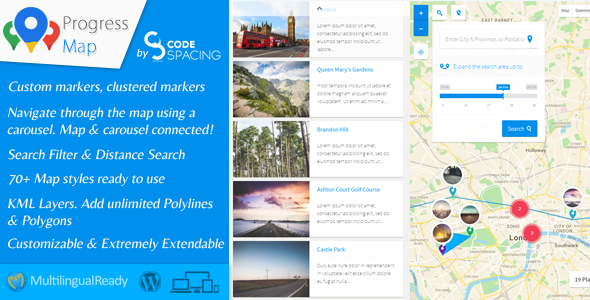
- Synced Map and Carousel Interface: The plugin pairs Google Maps markers with an interactive carousel that moves in perfect sync. When a user clicks a carousel item, the map zooms in on the corresponding location, and vice versa. This dual-navigation system makes it effortless for visitors to browse and explore multiple listings without getting lost.
- Unlimited Custom Post Type Support: Progress Map works with both default WordPress post types and any number of custom post types. You are not limited to a predefined set of content types, giving you complete flexibility to map anything from products to events.
- Advanced Marker and Clustering Options: Beyond standard markers, the plugin supports Advanced Markers, marker labels, SVG icons, and a unique Color Clustering system. This clustering approach uses a gradient color pattern that visually separates clusters based on marker density, making high-traffic areas immediately apparent.
- Comprehensive Overlay and Drawing Tools: You can add polygons, polylines, image overlays (ground overlays), and KML layers to your map. These overlays can be connected to specific posts, making their visibility dependent on the associated listing. The plugin now uses Terra Draw for admin drawing fields, ensuring compatibility with the latest Google Maps API versions.
- Powerful Search and Filtering: The built-in search form allows users to search by distance, with options to draw a circle around the search area. A faceted search lets visitors filter locations by categories, tags, or custom taxonomies. Geo-targeting can automatically detect the user’s location to show relevant nearby results.
- Performance and Caching: Recent updates introduced a map caching system to improve loading speeds. The carousel was migrated from jCarousel to SwiperJS for better performance and mobile responsiveness, and the heatmap layer now uses deck.gl for smoother rendering.
- Customizable Infoboxes and Modals: You can choose from multiple infobox styles, control their width and height, and decide whether they open on click, hover, or at a specific zoom level. Post content can be opened inside a modal popup directly from the marker or infobox, keeping users on your site.
- Frontend Submission and User Integration: With the available “Submit Locations” add-on, you can allow users to add locations from the frontend. The plugin also supports showing only the locations of the currently logged-in user, making it suitable for membership or community-based sites.
Who Is This For? Use Cases
Agencies and Web Developers
Digital agencies building directory sites, real estate portals, or store locators will find the Progress Map WordPress Plugin indispensable. Its ability to handle unlimited custom post types and its extensive admin panel mean developers can create bespoke mapping solutions without writing custom code. The plugin’s support for multiple map instances on a single page is a particular advantage for complex projects.
Real Estate and Property Websites
Real estate agents can display property listings on a map with polygons defining neighborhood boundaries. Buyers can filter by price, type, or location, and click on markers to view property details in a modal. The “Visited marker” feature allows agents to see which properties a user has already explored, providing valuable behavioral data.
Travel and Hospitality Blogs
Travel bloggers and hotel review sites can use the plugin to create interactive travel guides. Markers can represent hotels, restaurants, and attractions, while the carousel provides a browsable list of recommendations. The route map shortcode is perfect for showing a day-by-day travel itinerary connecting multiple destinations.
E-commerce and Store Locators
Businesses with physical locations can embed a store locator on their website. Customers can search for nearby stores, get directions, and view store-specific information such as hours and contact details. The plugin’s support for KML layers also allows for the display of delivery zones or service areas.
Job Boards and Classifieds
Job listing sites can map job locations, allowing candidates to find positions near them. Similarly, classifieds sites can show the geographic distribution of items for sale, from cars to furniture, enhancing the browsing experience.
Technical Details & Compatibility
The Progress Map WordPress Plugin is built to integrate seamlessly with modern WordPress environments. It is fully compatible with PHP 8.0+ and has been tested with the latest WordPress versions, including full-site editing (FSE) and block themes. The plugin uses the Google Maps JavaScript API and supports Map ID for advanced cloud-based features like custom styling and feature layers.
Compatibility extends to essential plugins and tools. It works with WooCommerce for mapping product locations, WPML for multilingual sites, and supports Content Security Policy (CSP) requirements. The carousel is built on SwiperJS, a modern, touch-friendly slider library that ensures smooth performance on mobile devices and small screens. The plugin also includes a troubleshooting section with options to combine or separate CSS and JS files, helping resolve conflicts with other themes or plugins.
For developers, the plugin offers extensive shortcode attributes, hooks, and filters. You can override nearly every setting—from map center and zoom level to infobox style and faceted search terms—directly from the shortcode. The admin panel is split into logical sections (Map settings, Marker settings, Clustering settings, etc.), making configuration straightforward even for users with limited technical experience.
Pros and Cons
Pros
- Exceptional longevity and support: With over 12 years of development and 6,300+ sales, this plugin has a proven track record of reliability and continuous improvement.
- Comprehensive feature set: From markers and clustering to polygons, KML layers, heatmaps, and route maps, the plugin covers virtually every mapping need without requiring additional extensions.
- Synced carousel-map interaction: The bi-directional sync between the carousel and map markers is intuitive and significantly improves user experience for browsing multiple listings.
- Performance-focused updates: Recent versions introduced a caching system, migrated to SwiperJS, and adopted deck.gl for heatmaps, demonstrating a commitment to speed and modern standards.
- Flexible licensing and value: Priced at $84.00, the plugin offers a one-time payment for a tool that would otherwise require multiple subscriptions for similar functionality from competitors.
Cons
- Learning curve for advanced features: While basic setup is simple, mastering all the options—such as drawing polygons, setting up KML layers, or configuring the faceted search—may require reading the documentation or watching the provided video tutorials.
- Google Maps API key required: Users must obtain their own Google Maps API key, which may incur costs depending on usage volume. This is standard for most mapping plugins but is worth noting for budget-conscious users.
- Dependency on Google Maps: The plugin is tightly integrated with Google Maps, meaning any changes to Google’s API policies or pricing could affect functionality. There is no built-in support for alternative map providers like OpenStreetMap.
Frequently Asked Questions
Does Progress Map work with the latest version of WordPress and PHP 8?
Yes. The plugin has been actively maintained and updated to ensure compatibility with the latest WordPress versions, including full-site editing (block themes). It is fully compatible with PHP 8.0+, and the changelog confirms specific fixes for PHP 8 compatibility issues. The developer, codespacing, has released multiple updates in 2025 and 2026, indicating active support.
Can I use Progress Map to create a store locator with a search-by-distance feature?
Absolutely. The plugin includes a powerful search form that allows users to search for locations by distance. You can set a radius, choose between kilometers or miles, and even draw a circle on the map to visualize the search area. The faceted search also lets users filter results by categories, tags, or custom taxonomies, making it ideal for store locators, restaurant finders, and similar applications.
Is it possible to display different markers for different categories of locations?
Yes. Progress Map supports multiple marker categories, and you can assign a custom marker icon to each category. This allows you to visually distinguish between different types of locations—for example, using a blue marker for hotels and a green marker for restaurants. You can also upload custom marker icons for individual posts from the post edit screen.
Final Verdict
The Progress Map WordPress Plugin by codespacing is a mature, battle-tested solution that has earned its place as a top-selling mapping plugin on CodeCanyon. With over 6,300 sales and a development history spanning more than a decade, it offers a level of reliability and feature depth that is rare in the WordPress ecosystem. The plugin’s ability to sync a carousel with map markers, support unlimited custom post types, and provide advanced tools like polygons, heatmaps, and KML layers makes it suitable for everything from simple store locators to complex real estate portals.
While there is a slight learning curve for the most advanced features, the extensive documentation, video tutorials, and responsive support from the developer mitigate this concern. The recent migration to modern libraries like SwiperJS and deck.gl, along with the introduction of a caching system, show that the plugin is not resting on its laurels but actively evolving to meet modern performance and API standards.
For anyone serious about adding professional, interactive maps to their WordPress site, the Progress Map WordPress Plugin delivers exceptional value at $84.00. It eliminates the need for multiple subscriptions or custom development, providing everything you need in a single, well-supported package. Whether you are an agency building client sites, a real estate agent showcasing properties, or a blogger creating travel guides, this plugin is a worthy investment that will elevate your website’s functionality and user experience. Visit the CodeCanyon page today to see the live demo and take your location-based content to the next level.